The Cost of Not Innovating
Australia ranks 7th out of 25 OECD countries in innovation. This is from a study of innovation active firms or businesses in Australia. How does our for purpose sector or not for profit and social enterprise sector rank globally? It doesn’t. Why? Because we don’t even bother to measure how innovative our sector is, globally or locally. Peter Drucker who said “what gets measured gets managed”, would say we clearly haven’t made much of a go of managing innovation in the for purpose sector.
This wasn’t always the case and isn’t always the case today. We have some important innovation awards and industry awards and we used to have a not for profit innovation index as recently as 2017. I know because I went to one of their events! It was small, but meaningful and provided an incentive and platform for not for profits who innovated to be rewarded for their efforts and to set an example for the rest of the sector. This isn’t to say that innovation isn’t happening in the sector. It surely is.
Mycelium, networks and surfacing best practice
It is happening at the coal-face and surfacing often at medium to large not for profits and social enterprises who have the funding, reputation and courage to share their innovation projects publicly. But much of it is hidden underground like mycelium. Mycelium is a breathing connected organism, much like how we are all connected through our neighbourhoods and activity. As humans, we need examples of best practice and industry leading examples to discuss, champion and aspire to.
If we look hard enough in the right places we can find them. These places are often hidden communities of practice or practice networks, where collaboration can thrive. This is important and should be promoted and further developed. These are places where trust has developed to the point where there is no fear of theft, attempts at replication or lifting others intellectual property. Sacred places where innovation practitioners and leaders work together for the benefit of the sector and the community.
Funding innovation and the five avenues
One of the most common questions I get when presenting about innovation in our sector is “how do you fund innovation in our sector?”. This will depend on a range of factors, for example:
Do you currently have an innovation budget? 95% of the time the answer is no.
Do you have a budget for product development or service improvement? It’s usually a yes, but not much and we use it for a range of things.
Do you have a training and development budget? It’s usually a yes, but not much. But we try not to spend it.
Do you have a corporate overhead? Yes, but it only funds our corporate and people and culture areas.
Do you receive government or philanthropic funding? Yes, but I didn’t think we could fund innovation from this.
The long and short of it is, there are five avenues listed above here that could create an innovation fund that you could use to support your innovation efforts today. The reasons listed above are not set in stone. They are a default choice. Default choices remain default choices unless we question them. The most common way I’ve seen for purpose organisations attempt to do innovation is through applying for relevant government or philanthropic funding to build new products or services, where innovation is stated as a core criteria or metric of success.
This is a shame, because it’s not easy to win grants. And you are essentially saying “yes innovation is important but only if someone else pays for it!" Well, what if you don’t win the grant? Will you wait for the next one? Will you not start your innovation journey at all? An alternative approach is to understand that developing a strong innovation program and culture can help you develop an edge, competitive advantage or unique value proposition that sets you apart from the rest. As Simon Sinek says - “leaders go first”.
The business case for innovation
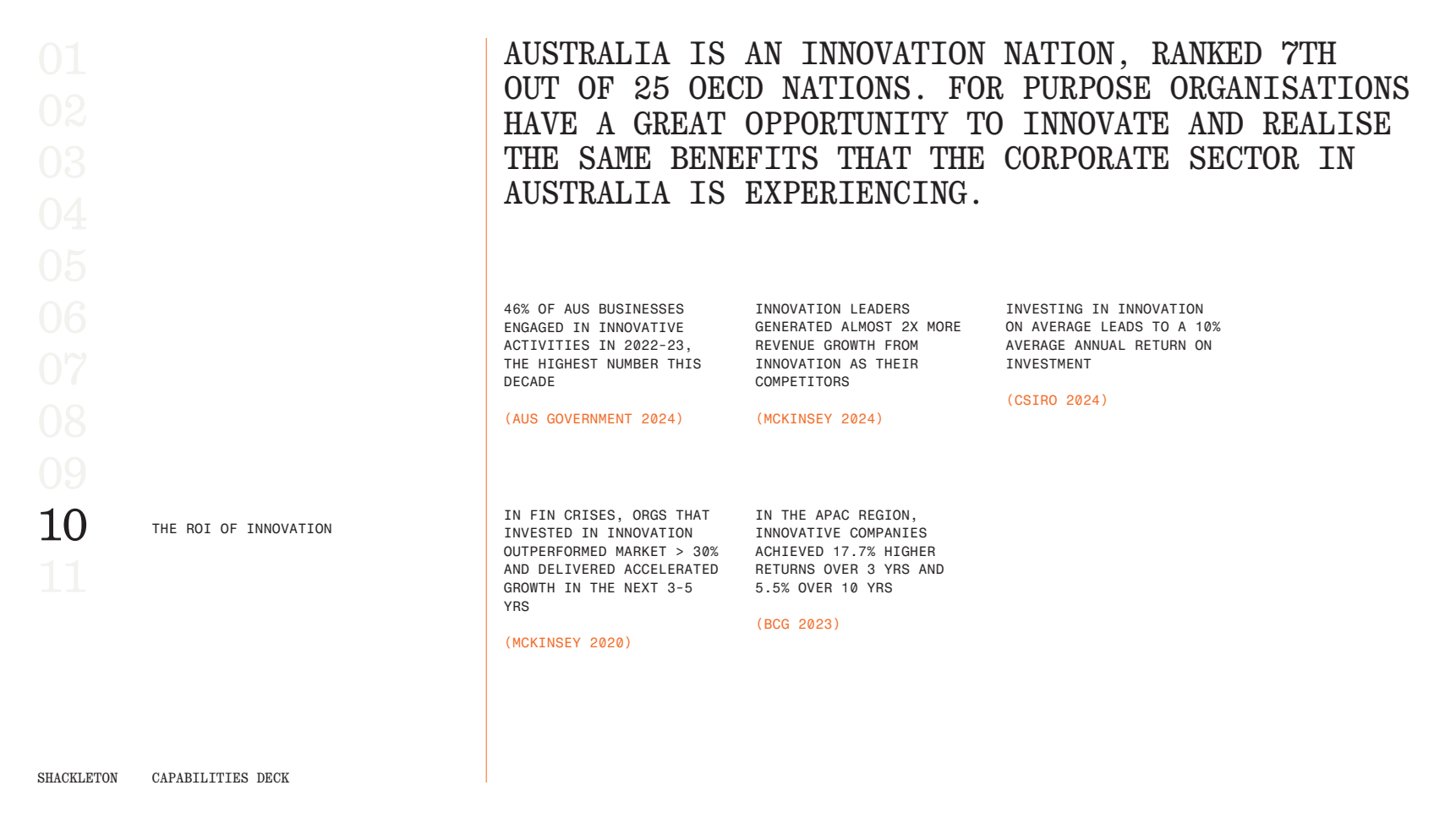
Experience and consulting with a range of leaders in our sector tells me that it takes a few years to develop a leading innovation program and culture in a given not for profit or social enterprise. So you are entitled to ask beyond the apparent, what then is the business case for doing so? Well, I’m glad you asked. Here is a slide I share at most of my presentations on innovation-
Capabilies Deck, Shackleton Labs 2026
As with most things in life the statistics tell us only some of the story. I would say that in a sector that traditionally struggles to catch up with the latest technology (capacity building) and skill development (capability building), that the returns from investing in innovation will be considerably higher because we are newer to it and there is a lot of early wins and low hanging fruit to be had. There is also the second-mover advantage we have from seeing corporate innovation success and being able to model from that as well as being at a point in time where we are seeing the true democratisation of technological innovation through the AI boon.
The AI boon if leverage well, ethically and safely has the potential to supercharge for purpose innovation for the next few years. It is more than likely that you have at least one or two or a handful of staff who are already superusers of ChatGPT, Copilot or Claude. Many are likely already in their spare or work time capable of or have started to build agents to do some of their work. These folks can be part of your innovation champions team.
